

Robbery Criminal Charges in Arizona
Under A.R.S. 13-1902
Today we’re talking about robbery charges in Arizona.
There are specific legal elements that must be present in order for conduct to qualify as robbery under Arizona law. If one of those elements is missing, then there may be strong defenses available in the case.
So we’re going to walk through what the law actually says, what those elements mean, how defense attorneys analyze robbery allegations, and what the penalties are for robbery charges in Arizona.
Arizona’s Robbery Statute
Robbery is found under Arizona Revised Statutes § 13-1902.
Arizona actually has three separate robbery offenses:
- Robbery
- Aggravated robbery
- Armed robbery
This article focuses specifically on robbery under A.R.S. § 13-1902, which is the base-level robbery offense. The more serious offenses — aggravated robbery and armed robbery — have additional elements and significantly harsher penalties.
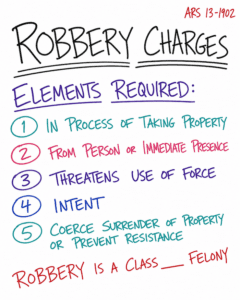
What Are the Elements of Robbery in Arizona?
In every criminal case, the government has to prove each legal element beyond a reasonable doubt.
That means robbery is not simply “taking something.” There are several specific requirements that all must be present.
The statute itself is somewhat cumbersome because everything is packed into one long sentence. As defense lawyers, we break those elements apart so we can analyze each one individually and identify where the prosecution’s case may fail.
1. The Taking Must Occur During the Taking of Property
First and foremost, the conduct must occur during the taking of property.
That sounds obvious, but legally it matters.
The statute specifically requires that the conduct occur “in the course of taking property.” So if property was never actually taken, or if the circumstances don’t line up with that requirement, that can become an important issue in the case.
2. The Property Must Be Taken From a Person or Their Immediate Presence
This is a critical element.
The property must either be:
- On the person, or
- Within the person’s immediate presence or vicinity
That means robbery is not simply taking property that belongs to someone else.
For example:
- Taking a wallet directly from a person
- Taking a purse sitting right next to somebody
- Taking property physically near them
Those situations are different from taking property when nobody is present.
So if somebody steals a vehicle while the owner is asleep inside a house, that may still be theft or another offense, but it may not satisfy the robbery statute because the property was not taken from the person or their immediate presence.
This is one area where defenses can arise. If the property was not actually on the person or within their immediate presence, then one of the required elements of robbery may not be met.
3. There Must Be a Threat or Use of Force
Another key component is force or the threat of force.
Under Arizona law, force has a very specific legal meaning. It is considered a legal term of art, meaning it is defined very specifically within the statutes and case law.
Generally speaking, the prosecution must show some type of conduct intended to coerce somebody into surrendering property or prevent them from resisting.
That does not always mean a weapon was involved. It does not necessarily require physical injury. But there must be some level of force or threatened force connected to the taking.
4. The Conduct Must Be Intentional
Intent is another essential component.
The prosecution must prove that the conduct was done intentionally.
In criminal law, you need both:
- A physical act, and
- A required mental state
Here, the mental state is intentional conduct.
That means the person must knowingly and intentionally engage in the conduct. If events happened accidentally, unknowingly, or without the required intent, then the state may fail to prove this element.
5. The Conduct Must Be Intended to Coerce Surrender of Property
Finally, all of these elements must add up to one ultimate purpose:
The conduct must be intended to either:
- Coerce somebody into surrendering property, or
- Prevent them from resisting the taking of property
That final purpose element matters because it ties the entire statute together.
How Defense Lawyers Analyze Robbery Cases
When we defend robbery charges, we break every part of the statute apart piece by piece.
We analyze:
- Whether the property was actually within the person’s immediate presence
- Whether force actually occurred
- Whether there was a true threat
- Whether intent can actually be proven
- Whether the conduct fits the statutory definition
If even one of those elements is missing, then there is a strong argument that the robbery statute has not been satisfied.
That is why these cases are much more technical than people often realize.
Penalties for Robbery in Arizona
Arizona has six classifications of felony offenses:
- Class 1 felonies are the most serious
- Class 6 felonies are the least serious
Robbery under A.R.S. § 13-1902 remains a Class 4 felony in Arizona.
That places it roughly in the middle of Arizona’s felony classifications. It is a serious charge with potentially significant consequences, including prison exposure depending on criminal history and the facts of the case.
One important update under current Arizona law is that felony sentencing ranges can vary significantly depending on prior felony history, dangerousness allegations, and repetitive offender classifications under Arizona’s sentencing statutes.
So even though robbery itself remains a Class 4 felony, the actual sentencing exposure can change dramatically depending on the circumstances of the case.
Why Robbery Charges Need to Be Taken Seriously
If you or somebody you know has been charged with robbery, it is important to understand that these are serious felony allegations.
Even though robbery is not the highest felony classification in Arizona, it still carries major consequences and can permanently impact:
- Employment
- Professional licensing
- Firearm rights
- Housing opportunities
- Immigration status
- Future sentencing exposure
These cases often involve surveillance footage, witness statements, police interviews, forensic evidence, and identification issues, so it is important that every aspect of the case is reviewed carefully.
Speak With a Defense Lawyer About Your Case
If you or somebody you know has been charged with robbery in Arizona, it is important to have a plan moving forward.
Every robbery case is different, and the defenses often depend on the exact facts, the alleged use of force, witness credibility, and whether the statutory elements can actually be proven.
There are certain elements (requirements) that a person has to commit in order to be found to have committed a robbery charge. We will then talk about what will classify the level of robbery to a felony.
How do you find out about Robbery charges in Arizona?
It’s at the Arizona Revised Statue – you can look up ARS 13-902. There are different levels of robbery; you have a regular robbery, and then aggravated robbery, and then there’s armed robbery.
In today’s video, we will only be discussing robbery, not the other two.
What does a person have to do? Where does their mental state have to be in? What conduct/action do they have to do in order to be accused of robbery?
In order for it to be considered robbery, it needs to be in the process of taking the property, not your own. The property that has been taken needs to be on the person or immediately around your vicinity. Needs to be right in their presence. It’s not about taking the property of someone who is not around, it’s not taking someone’s car; it’s more of taking something (property) from that person.
Example:
Taking their wallet from their person. It’s taking something that’s physically on them or near them. If it’s not within the person, then that can be used as a defense tactic. You can make the argument that the property was not on the person or near them, therefore, that requirement of robbery will not be met.
Also, in a robbery, there needs to be a certain amount of force; there’s a different video about force.
What this means is a physical activity that needs to be done intentionally of their own will; if some of these acts are done accidentally, it does not complete the element of intent. In law, the word intent means that the person is in the right mental state and they are acting with intention. Once everything has been added up, 1-4, then the person needs to coerce or have the alleged victim surrender/resist in giving up their property to the person.
As lawyers, when we defend someone, we break down all of these elements to use in our defense, in law, and under the statute, all of these elements are put together. It’s important to know that each one of those elements has a different legal definition. What we want to do here is look at the facts on your case and see where they do not align with the elements of the statute; there could be a good argument that you are actually not guilty of robbery.
Now that we know the requirements of being classified for robbery, let’s take a look at the penalties. In Arizona, we have 6 classifications of felony offenses. Class one felony is the most serious one, class six is the least. Robbery is a class four felony. This is not at the low end of a felony, but it is still serious.
Free Consultation with Arizona Robbery Lawyer
If someone you know has been charged, it is important to speak with an attorney. If you are not able to afford one, you can still speak with private Counsel. Our office offers free case evaluations.