
Possession of Dangerous Drugs and Defense Strategies in Arizona

Today we are discussing defenses to the charge of possession of dangerous drugs in Arizona.
In another article, we talked about what dangerous drugs are and what they’re considered under Arizona law. Here, we’re going to talk about some defenses that may apply if you’ve been charged with possession of dangerous drugs.
There’s a lot going on in these cases. Really, we could spend a lot of time breaking down each issue, but we’re going to focus on three main sections:
- Possession
- Identification of the drug
- General criminal defense strategies
Possession Is Not Always Clear
First, possession is a big issue.
Possession is not as clear as it might seem. Somebody might think, “Well, I was in possession of it,” but what does that mean legally?
Remember, in the law, it is very specific. We have to get very technical with it.
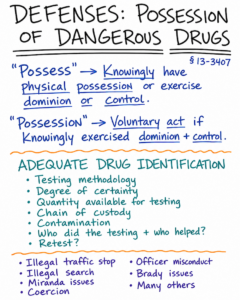
Under A.R.S. § 13-105, Arizona law defines possession by looking at whether a person knowingly had physical possession or exercised what is called dominion or control over the item.
That creates a lot of gray area. There is a lot of room to make arguments.
What Is Dominion or Control?
What actually is dominion? What is control over something?
There is a major difference between something being in somebody’s purse and something being in a glove box. It may only be one foot away, but legally it can be very different.
If something is in someone’s purse, it is on their person. They likely have control over that. If something is in a glove box, the question becomes whether that person actually had dominion or control over it.
Dominion means whether someone had some ability to exercise control over that area or object. There is a lot of case law about what constitutes dominion and what constitutes control, and that creates room for legal arguments.
The “Knowingly” Requirement
Another major issue is whether the person knowingly possessed the item.
Possession requires a voluntary act. The person must knowingly exercise dominion or control.
If someone did not know the item was there, or did not know what it was, that can become a very important defense.
You do not want to skip over this part too quickly. There can be strong arguments about whether possession was actually proven.
Proper Identification of the Drug
Once we get through the possession analysis, the next major issue is proper identification of the drug.
Just because something looks like meth or looks like some other dangerous drug does not mean that it actually is.
An officer cannot simply come into court and say:
- “It looked like meth.”
- “It smelled like meth.”
- “They acted like they were on meth.”
That is not enough.
They also cannot simply use a quick field test and call it a day. The government has to go through a much more rigorous process.
The Beyond a Reasonable Doubt Standard
The government must identify the drug in a way that proves the case beyond a reasonable doubt.
You may have heard that phrase in movies. Beyond a reasonable doubt is the criminal standard the government has to meet. It is the highest standard we have in American law.
If there is reasonable doubt about what the item was, whether it was a dangerous drug, or whether it was something else, then the government may not meet the elements of the offense under A.R.S. § 13-3407.
Testing Methodology
One of the first questions we ask is what testing methodology was used.
Are they performing the test to a degree of certainty that allows them to come into court and testify in front of a jury that the substance meets all elements beyond a reasonable doubt?
Is the crime lab proving the substance beyond a reasonable doubt within a certain scientific degree of certainty?
That is technical language, but it matters.
Quantity Available for Testing
The next thing we look at is the quantity available.
In many situations, there may be almost nothing to test and almost nothing for the defense to retest.
Do they have enough of whatever they are claiming is a dangerous drug to actually take it into the crime lab and test it to a degree of certainty that is acceptable in court?
Sometimes they do not.
They may presume it is what they think it is, but when it comes down to testing, do they have a full package of something, or do they only have a few molecules or residue left over?
That can be a major issue.
Chain of Custody
- The next issue is chain of custody.
- How was the alleged substance transferred?
- How was it pulled out of a vehicle or home?
- How was it impounded into evidence?
- Who transported it from the location to the evidence locker?
- Who took it out of the evidence locker?
- Who performed the testing?
- Who was involved in the process?
That entire process is called chain of custody.
If you can break the chain or identify flaws or weaknesses in that chain, that can be a strong defense because it creates doubt about the actual identification of the drug.
Contamination and Lab Issues
We also look for contamination issues.
All crime labs deal with contamination. They will acknowledge that. The question is how much contamination may have impacted the actual results. We also want to know who performed the testing.
- Who was the person who tested the substance?
- Who helped?
- Who filled out the paperwork?
- What are their credentials?
- What does their background look like?
- If the person involved in the testing has credibility issues, errors, or other problems in their history, that can create doubt in the case.
General Criminal Defense Strategies
Finally, there are standard criminal defense strategies that apply across the board, whether it is a DUI case, a domestic violence case, or a possession of dangerous drugs case.
Illegal Traffic Stop
If the drug was found during a traffic stop, we look at whether the traffic stop was legal.
If the officer had no reasonable suspicion to conduct the stop, then the stop may have violated the Fourth Amendment.
If the stop was illegal, then everything the officer gained after that may be thrown out.
Illegal Search
The same applies to an illegal search.
If an officer entered a home without a valid warrant, and there were no exigent circumstances or other legal basis to enter, then anything obtained after that entry may be excluded.
That can be a major issue in a drug case.
Miranda Issues
We also look at Miranda issues.
Was someone forced to give statements to police?
Were they properly advised of their rights under Miranda v. Arizona?
Was there coercion?
Were the statements voluntary?
If not, those statements may be challenged.
Officer Misconduct and Brady Issues
We also look at officer conduct.
Were officers doing things improperly or illegally?
Were there any Brady issues?
Brady issues involve information that may affect an officer’s credibility, including prior dishonesty, integrity violations, or other personnel issues that should be disclosed under Brady v. Maryland.
These defenses are not specific only to possession of dangerous drugs, but they are still important and must be reviewed.
Why These Cases Require a Detailed Defense Strategy
As you can see, there are many different defenses to possession of dangerous drugs.
It is a matter of going through the process carefully.
These cases are felonies. They can take a long time to process. There may be interviews, supplemental discovery requests, lab records, testing issues, officer reports, and constitutional issues that all need to be reviewed.
If you have been charged with possession of dangerous drugs, it is a serious charge. You want to make sure all of these areas are being examined.
Speak With an Arizona Drug Crimes Defense Attorney
If you would like to speak with our criminal defense team about a possession of dangerous drugs charge, we have a detailed process that we go through in each case.
We can explain how the process works, what defenses may apply, and what we may be able to do for you.
We offer free case evaluations and look forward to speaking with you soon.